

Eddie Sauter, Stock Arrangements and “Sandstorm”


For many music listeners, the first thing that comes to mind when the name Eddie Sauter is mentioned is an album by Stan Getz called Focus. This is a suite for solo tenor saxophone and string orchestra where Getz plays improvised solos with little to guide him, a musical trapeze artist without a net. This album has grown in stature since it first came out, and the music was finally published after being passed around via copies of the original parts, which were filled with errors and poor notation (Eddie’s son Greg, an excellent composer himself, consulted on the edition using Eddie’s sketches). This work has now been performed by many artists who add their own virtuoso musical improvisations. There is even a separate full score (and PDF) available for purchase. Here’s a snippet of Focus on the Edie Adams Show.
However, Eddie Sauter was an important composer/arranger during many eras of music. Originally a trumpet/mellophone player, his earliest professional arrangements were for the Roger Wolfe Kahn dance orchestra, active during the late 1920s – early 1930s. He next played and wrote for Red Norvo’s orchestra that played swinging accompaniments that were somewhat soft in volume so they didn’t drown out his xylophone playing, but rose in volume when accompanying Mrs. Norvo, the legendary Mildred Bailey. Eventually Norvo had to reorganize because ballroom owners complained the orchestra wasn’t loud enough. Sauter later joined the Benny Goodman orchestra and wrote a lot of wonderful arrangements of pop songs, vocal backgrounds, and original solo pieces for Goodman such as “Clarinet a la King” and “Benny Rides Again.”
After the war, Sauter wrote for Woody Herman and Artie Shaw, including a version of “Summertime.” Shaw refused to cut it when it was recorded, so it occupied a 12” 78, making the RCA Victor label pretty unhappy since it didn’t fit in jukeboxes. This setting is acknowledged as a masterpiece, and Shaw was still playing it when he reorganized his band toward the end of his life. But Sauter’s biggest break in 1946 involved a drummer and an agent.
Willard Alexander was an important manager of big bands during that era and many years after, and he convinced drummer Ray McKinley to put together a unit that would feature ‘progressive’ music ala Stan Kenton, whose orchestra was quite popular playing challenging ‘modern’ music as well as riff tunes and pop songs. McKinley had turned down the opportunity to lead the Glenn Miller ‘ghost’ band (he served with the Miller AEF band during the war), was a nice guy, an exciting drummer, and a vocalist with a ‘down-home’ personality originally from Texas. Sauter became chief arranger; he was later joined by Deane Kincaide. The orchestra began playing gigs in early 1946, and reportedly was playing well-known big band standards as Sauter’s challenging new music was still being rehearsed, but soon the public heard Sauter’s originals as well as pop songs and novelties that “Mr. Mac” sang. This schizoid approach wound up working beautifully, primarily because as ‘out’ as Sauter might have gotten musically, whatever he wrote had a danceable beat as opposed to a lot of music Pete Rugolo wrote for Kenton and George Handy wrote for Boyd Raeburn, so dancers were satisfied and modern music listeners delighted in Sauter’s new music drenched in Bartok and Stravinsky.
The subject of this presentation is one of Sauter’s earliest compositions for McKinley, a piece with the title “The Green Eye” on the manuscript, but was published as “Sandstorm.” “Sandstorm” exists in two forms – the original manuscript score and a published stock arrangement.
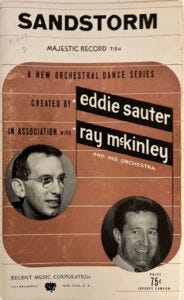
At one time the standard format for printed big band music (the octavo size is immediately recognizable), many of my readers may have never seen or played from a stock arrangement at this point in time, a term describing arrangements that were prepared by publishers for bands, dance ensembles, and orchestras that were sold or ‘stocked’ on music dealers shelves for anyone to buy and use since the 19th century. A full article on stocks should be written, but for now, we will deal with the basics as they apply here.
Let’s start with Sauter’s original. The instrumentation is:
alto,
alto/clarinet,
tenor/clarinet,
tenor,
baritone,
3 trumpets,
2 trombones,
guitar,
piano,
bass, and
drums.
I’ll be going into some details, so here is the recording from 7 March 1946. Please listen to this a couple times to absorb what Sauter has done musically. He also has a big surprise at the end!!
The melody is stated from 0:18–0:36. Note that he has an eighth-quarter-eighth pattern in fourths, and then quarter notes. At 0:55, the melody in the saxes returns but now a muted growl trumpet solo is added, which is played differently that what was in the score (I don’t have copies of the original parts to see what was indicated there; no doubt they were changed from what was originally written). At 1:06, there is a clarinet solo which is once again improvised, although Sauter wrote a notated part. Perhaps Sauter notated the kind of solo he wanted, and let the players go. Another trumpet solo appears that was written and played pretty much as notated.
A ‘middle section’ appears at 1:32 which once again features solos, this time trumpet and trombone, the trumpet playing freely and the trombone sticking close to what was written. At 2:12, Sauter builds upon his use of four eighth note phrases. The parts indicate an improvised trombone solo which isn’t played, and trumpets keep building, finally ending with all of them in harmony (2:27). The recap starts with trumpets and trombones trading phrases of the melody (2:29), once again building up to a big ending, except Sauter plays a trick on our ears. We think this piece is simply going to end big in the composition’s key of F Major, except that after a big F6 chord in the brass, they drop out and the saxes continue with a unison melodic line in F# minor!!!
In 1946, arrangers were generally still writing out full bass parts, and Sauter does that here. Some arrangers were writing out full piano parts, but this part has chord changes most of the time, except when Sauter needed something specific. Chord names are basic; altered pitches (such as #9) are not indicated.
At some point, the publisher decided to issue a stock arrangement of the piece, which is really quite extraordinary given the ‘advanced’ style of the music. The publisher is Regent Music, owned by Benny Goodman and run by his brother Harry. I obtained a copy from Gene Goodman when Warner Bros. Publications had a print deal with them (not only did they publish jazz, but early rock and roll and R&B). Gene allowed me to take copies of anything I wanted, so I got some interesting stocks. This was some years before I obtained a copy of Sauter’s manuscript score and a set of parts which were not the originals.
When a stock of a recorded arrangement was prepared and issued (imagine, you could get a version of Artie Shaw’s version of “Begin the Beguine” that sounded almost like the record for 75 cents!), the original score most certainly was consulted, since transcribing it from 78 RPM discs would have been quite a chore. From examination of the score I reconstructed from the stock, this had to have been the case, since there were things that would not have been easily heard and only determined from an original source.
Instrumentation for stocks had undergone changes since the early days of the swing era. Back in 1936, there were four saxes, three trumpets, one or two trombones, guitar, violins, piano, and bass (there were always violin parts even if these weren’t on the recording). By 1946, this stock’s instrumentation was five saxes, three trumpets, three trombones, guitar, piano, bass, and drums.
The first thing that had to be done was to alter the sax parts, since stocks were arranged to be played by two or three saxes by 1946; alto, tenor, and alto, in that order. The tenor was a true second part, so that the alto and tenor parts would sound adequate by themselves. The trumpet parts had to ‘sound’ with two trumpets, which is why the 3rd trumpet part was usually all over the place, with the extra notes that were not essential or were covered elsewhere in the saxes or trombone parts. The arrangement also needed to work with one trombone.
Additionally, as noted above, the first 1946 McKinley band only had two trombones. The 3rd had to be added for the stock.
Who did this work? It might have been Sauter; he wasn’t the only arranger who wrote something that had to be adapted, and at least if he did it, it would be somewhat definitive. To use the example of Shaw’s “Begin the Beguine,” Jerry Gray was the original arranger and is credited on the stock. People like Lyle ‘Spud’ Murphy wrote for the Casa Loma Band, and he was a prolific arranger of stocks, so he knew the drill as well. Or in the case of that 3rd trombone, Sauter might have added it later for McKinley’s band, since there were indeed three trombones in the ensemble by July at the latest.
So in the saxes, solos were moved around; the clarinet doubles were in the 1st Alto and 2nd tenor in the stock vs. Alto 2 and Tenor 1 in Sauter’s original score. The piano part is fully notated, of course not what was on the record.
But this publication has one of the most bizarre errors I’ve ever seen in a stock, and I’ve seen some beauts! Remember the trumpet soli at ca. 2:20 – 2:27 before the recap? The three trumpet parts are all written IN CONCERT, a tone below what would have been correct. One wonders how that happened. Stocks were hand-copied and were supposed to be played through before publication by a local band. How did this get past the publisher? How did this happen in the first place?
Back then, there were such things as ‘engraver’s manuscripts’ where an editor supplied the master score to an engraver or a copyist to prepare parts (obviously stocks and indeed most concert band publications did not come with full scores). Was there an engraver’s manuscript and was it written in concert, and the copyist forgot to transpose the trumpet parts in that section? Possible. However, the end result was still the same: unless there was a brave soul to go through the trumpet parts by listening to the recording and fixing them, the stock was worthless!! My guess is that whoever bought this had the parts removed from the book and just tossed them. And 75 cents back then was a lot of money!
I have no way of knowing what the print run for this was, but I’ll bet it wasn’t more than 1,000 copies. I wonder what happened to unsold stock once Regent discovered that this publication had a major error like this one. Most of them that may still exist are crumbling, as this was an era where paper was highly acidic, turned brown and became fragile.
The end result is that I now have two edited scores: one based on the original and one based on the stock for my ensemble workshops and arranging students. At least players don’t have to deal with mis-transposed trumpet parts now!!!
The post Eddie Sauter, Stock Arrangements and “Sandstorm” appeared first on ASMAC.
 | A guest post by
|