
Robert Farnon (Part 1)


The Best of the Best
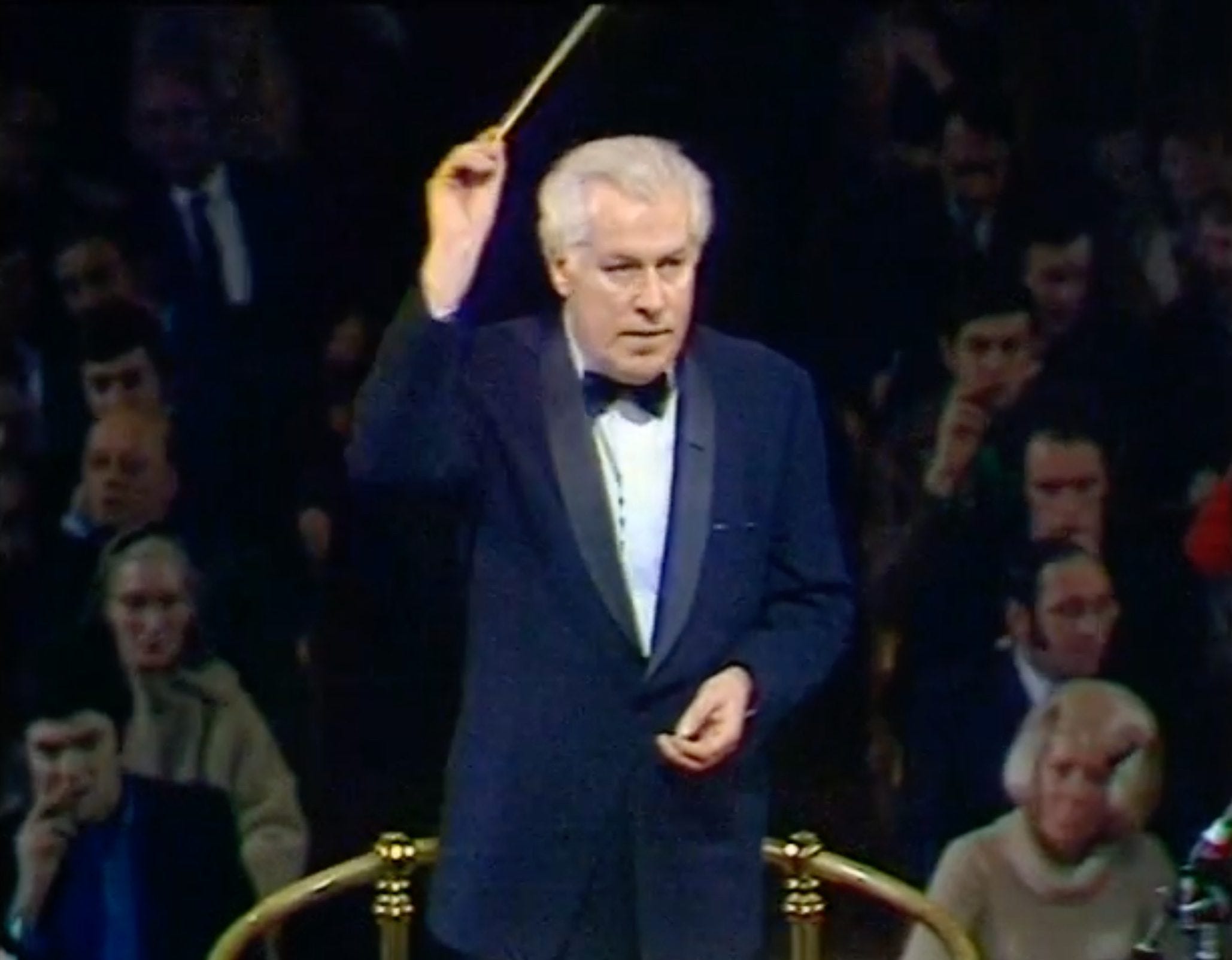
Robert Farnon conducting his arrangement of “A La Claire Fontaine.”
This is the first of a long series of articles about an arranger/conductor who is acknowledged to be perhaps the most influential and innovative of the twentieth century. Of all the composer/arrangers who are rarely discussed today and probably not heard very much anymore, he was indeed a master, and he needs to be rediscovered.
There are many music creators who were not born here in the U.S., and either came here, or made careers for themselves in various countries. Here was a man who was born in Canada, came to the U.K. during WWII, stayed there, but had a brief flirtation with the U.S. music scene before returning to the U.K. In his later years, his career had a renaissance and major stars ran to him to write projects for them.
Robert Farnon may have possibly influenced more composer/arrangers than anyone in the 20th Century. John Williams and André Previn praised his music in interviews, Billy Byers and Marion Evans would recommend his recordings to other arrangers as models of the craft. J.J. Johnson and Dick Hazard had high praise for him. Herbie Hancock has gone on record saying that Farnon is his favorite arranger, and John Clayton and I had a wonderful conversation about our favorite Farnon scores. There are many more I can name.
His albums for U.K. Decca (distributed here by London Records) were grabbed by arrangers when they were first issued in the 1950s, and were collector’s prizes years after they went out of print. They were reissued by Dutton Vocalion in the early 2000s, disappeared from its catalog some years later, and are similarly collector’s prizes. Arrangers knew not to lend them out, several told me they did so and didn’t get them returned (Jerry Lewis didn’t return Farnon albums lent him by Brian Farnon, the composer’s brother. Farnon wrote arrangements for Lewis when he performed in Las Vegas).
His story will be told in the following segments. For now, I will simply say that I knew and worked with him in the 1980s onward, editing and correcting his music. I volunteered for this; I wanted to study his music, and it was a way of giving back and creating a master class for myself. Payment was reading those scores when they were finished and discussing them with him.
So as an introduction, let’s hear some of his classics:
He wrote Yes, We Have No Bananas during WWII specifically for a radio broadcast.
Another arrangement he wrote when the theme was new, Laura. Composer David Raksin loved this recording.
Farnon trained to be a concert composer, and wrote two symphonies when he began his career in Canada. He subsequently withdrew them, considering them juvenilia, and also because he later reused melodies from them. Perhaps his most well-known and beloved concert work was based on a Canadian folk song, A La Claire Fontaine, which he wrote after the war. I cannot tell you how many arrangers have told me how influential this was to their discoveries as music creators.
In 1962, Frank Sinatra did a world tour raising money for charity. He had heard about Farnon and wanted to make an album in England. Unfortunately, he was not in prime voice when he entered the studio, and this was the only Reprise album that was not released in the U.S. until many years later. Nelson Riddle told me he was at the sessions. This is one of my favorite Sinatra recordings: “A Nightingale Sang in Berkeley Square.”
Farnon was commissioned a Captain in the Canadian Army and led the Canadian Band of the Supreme Headquarters Allied Expeditionary Force during WWII. Because this was the equivalent of the American band of the SHAEF, he befriended Glenn Miller, who had a great deal of respect for him. While in England, he moonlighted writing for the Ted Heath and particularly the Geraldo bands. Here is one of his arrangements for Geraldo with a vocal by Carole Carr, a song by Irving Berlin for the movie “Blue Skies,” Getting Nowhere.
As I wrote earlier, in his later career, Farnon had his pick of the biggest stars in the business who wanted to make albums with him. Here is Joe Williams singing “Here’s to Life.” Williams told me that making this album was one of the great thrills of his career.
This is a sampling of what is to come. We will start from the beginning in our second visit.
The post Robert Farnon (Part 1) appeared first on ASMAC.
 | A guest post by
|