
The Forgotten Earle Hagen (Part 3)


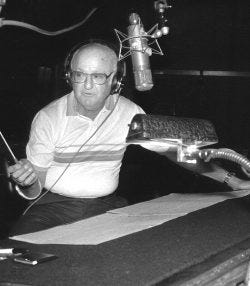
The Liberty Records label started out recording jazz albums; their first major artist was Julie London. Both Spencer and Hagen made record dates for the label for a short time. Here they back London on the song Dark, originally issued as a single only.
Jeff Chandler was one of the most popular actors of the period, and he was also a good singer who originally made several records for Decca. Signed by Liberty, Spencer-Hagen made an album with him:
Lincoln Chase was a songwriter who wrote a lot of hits for others, like Such a Night which was recorded by The Drifters and Johnnie Ray, and Jim Dandy, recorded by LaVern Baker. He made an album in 1957 with Spencer-Hagen.
And Spencer-Hagen made another album of mood music — Essence of Romance
Hagen continued to work on major Hollywood musicals and dramatic films as an orchestrator, including “Love Me Tender,” “Will Success Spoil Rock Hunter,” “The Young Lions,” “St. Louis Blues” (with Nat King Cole), “The Diary of Anne Frank,” and “Compulsion.” All in a day’s work!!!
Back to television. Here is a complete segment of My Sister Eileen from 1960 with Elaine Stritch. Spencer and Hagen split up their partnership after working on this series.
Hagen is credited with the theme music for The Barbara Stanwyck Show, but since this is an early segment in the run, it is likely he did the entire score. Note that this intro was only used for the first few episodes; further episodes used a variant of the end titles.
Also broadcast was The Bill Dana Show. Hagen wrote the theme; the music was scored by Irving Szathmary, Dana’s younger brother, who would go on to score Get Smart.
These were the years of Hagen’s biggest shows — “The Andy Griffith Show,” “The Dick Van Dyke Show,” “Gomer Pyle USMC,” the first year of “That Girl,” “I Spy,” and “The Mod Squad.” But there were other shows that came and went.
Mary Hartman, Mary Hartman, in which Hagen wrote the theme and a stock music library without seeing the show first.
And a fitting end, the theme from The New Mike Hammer, which was Harlem Nocturne.
Hagen wrote two books on writing music for film—Scoring for Films and Advanced Techniques for Film Scoring, and taught many students; tuition was golf balls! He also studied twelve-tone music with the pioneering composer/theorist George Tremblay1, and published a textbook of Tremblay’s unique approach, which is worth finding and exploring, The Definitive Cycle of the Twelve Tone Row.
Hagen left us in 2008.
[Ed. note: Earle Hagen’s papers 1955–1968, including music scores for TV series and records of the time, are located at the American Heritage Center, University of Wyoming. ]
[Ed. note: Read Memoirs of a Famous Composer—Nobody Ever Heard Of by Earle Hagen.]
Footnotes
1 George Tremblay archive is available at the University of Maryland, Michelle Smith Performing Arts Library.
The post The Forgotten Earle Hagen (Part 3) appeared first on ASMAC.
 | A guest post by
|